

Unlike other forms of competition, warfare is the ultimate zero-sum contest, distilling strategy into its purest and most ruthless form. As such, we naturally turn to military history for business strategies and Sun Tzu’s Art of War is the established standard. It provides an excellent framework for tactical competence and is understandably popular. However, to develop a fully nuanced perspective, we must look beyond the immediate and the obvious.
For me, a far richer source of strategic wisdom comes from The Romance of the Three Kingdoms (ROTK). This sprawling epic is invaluable because its focus is not on winning a single campaign, but on the deeply human, slow-moving dynamics of regime survival and statecraft.
For us as investors, I believe it serves as a powerful lens for understanding industry structures, interpreting competitive behaviour and spotting inflection points. This post shares only a small slice of what the full text has to offer from my personal interpretation, and I highly encourage anyone who has further interest to explore Luo Guanzhong’s full epic (For this post, I referenced the Brewitt-Taylor translation).
In the next post, I plan to apply this ROTK framework to an industry the market has discounted due to near-term external pressures. Examined through ROTK’s lens, the true deeper structural forces, such as unchallenged operational efficiency or defensible niche legitimacy become clearer, revealing strengths that are currently underappreciated in the market’s near-sighted narrative.
Thanks for reading! If you want to know which discounted industry the market is sleeping on and how the ROTK framework reveals its unseen structural resilience, be sure to subscribe to get the next post shipped to your inbox. Gain the strategic foresight to read the map before the financial metrics confirm the pivot. Your support fuels this mission to find wisdom where others overlook it.
The Empire Before the Storm
Every enduring system, be it imperial or institutional, contains within it the conditions of its own undoing.
The very mechanisms that once enabled dominance such as scale, structure, centralization over time, calcify into fragility. The Han dynasty (206 BCE – 220 CE), towering over China for centuries, offers a masterclass in this paradox. It possessed the bureaucracy, the mandate, and the historical momentum of a unified order.
But by the late 2nd century, its legitimacy had stretched thin, propped up by rituals, not results. Corruption hollowed the court. Local rebellions hardened into movements. And the public, once deferential to Heaven’s chosen rulers, had begun to look elsewhere.
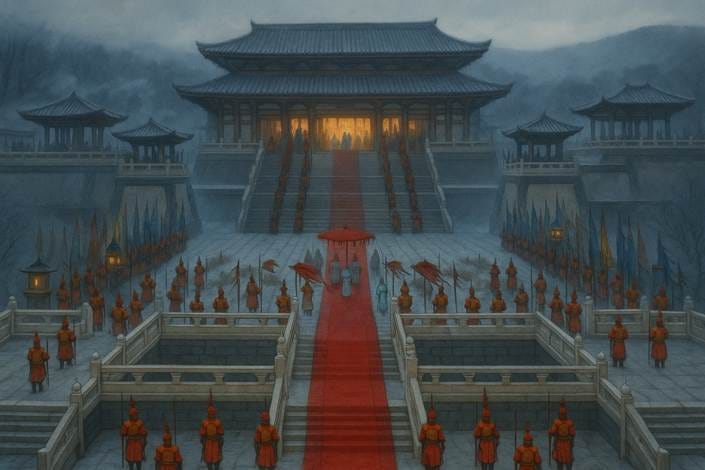
A fading dynasty clings to ceremony, even as ambitious warlords gather strength beyond the gates.
As the Romance of the Three Kingdoms (ROTK) opens, it offers a refrain as cold as it is enduring.
“The empire, long united, must divide; long divided, must unite.”
This is no poetic flourish but a strategic truth. No structure, no matter how revered or well-capitalized, escapes the cycle of rise, stagnation, and revision. That logic applies not just to dynasties, but to firms, sectors, and incumbents of all stripes.
We see this play out whenever a dominant player, once unshakable, suddenly starts missing a step. A gap opens between competence and confidence. Innovation slows, policy tailwinds dry up, or customer trust thins. The numbers may still impress, but the narrative frays. And like regional governors raising their own banners in defiance of Luoyang’s hollow throne, insurgent challengers begin to emerge. Leaner, hungrier, unencumbered by legacy.
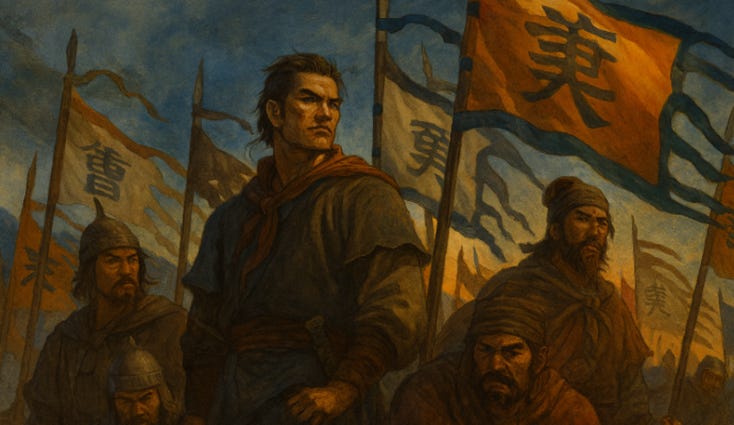
When legitimacy falters, new banners rise
This is the prelude to strategic change. Quiet, deliberate, and building beneath the surface. The discerning mind, in any era, learns to recognize the signs. When stability conceals fatigue and dominance slips into routine.
A legacy automaker doubling down on outdated platforms. A streaming giant defending volume instead of value. A financial institution overexposed to the same risks it once helped mitigate.
All the while, beneath this surface, pressure builds. Technology shifts, consumer sentiment evolves, regulatory winds shift course.
These are the twilight hours before the real battle begins.
What made the fall of the Han relevant and ROTK enduring, is that it teaches us to see succession not as anomaly, but as inevitability. And in business, this translates into a sharper form of vigilance.
For investors, it means paying attention not only to earnings, but to erosion. To the quality of leadership signals, to the agility with which a company renews its claim to legitimacy.
The core idea is simple but profound. Once the centre shows weakness, it stops anchoring the system. What follows is not collapse, but realignment. The map redraws itself. And those prepared for the moment, who have been building and watching patiently, step forward.
The Mandate of Legitimacy
In imperial China, authority was never purely about coercion. It was rooted in a higher moral sanction, the Mandate of Heaven. An emperor ruled not simply because he could, but because the heavens and the people believed he should.
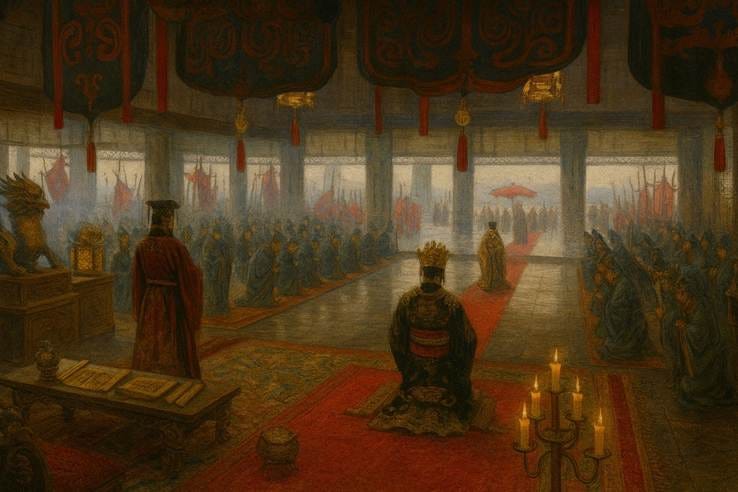
Coronation is ceremony, legitimacy is judgment
Natural disasters, famine, rebellion were not just misfortunes, they were warnings signs that the ruler’s mandate was slipping.
The modern economy may lack celestial omens, but it offers a parallel in the form of legitimacy. This is the unspoken permission a company earns from regulators, investors, and the public to lead its industry. It is not just about market share or margin but also about moral capital.
When a firm is seen as trustworthy, principled, and aligned with public interest, it gains a form of invisible leverage. It can make mistakes and still retain loyalty. It can move into new markets and be granted the benefit of the doubt.
This legitimacy does not come from marketing alone. It is built slowly, often through reliability and transparency. A carmaker known for decades of safety, or a tech firm with a long track record of privacy protection, holds a mandate that cannot be easily copied. It is the compound interest of trust.
But just as the Han dynasty’s collapse accelerated once the people believed its rule was no longer righteous, modern legitimacy can unravel quickly. A scandal, a breach, a misstep. Suddenly the glow fades. The same media that once celebrated becomes critical. The regulator who once nodded now asks questions. And competitors, sensing the shift, press in.
This is not theoretical. Boeing’s fall from grace after the 737 MAX crisis was not so much about aeronautics as it was about trust. Facebook’s string of data controversies did more than draw headlines, they opened space for rivals to claim moral superiority. And newer firms, like those in the electric vehicle space, have built much of their ascent not just on products, but on the perception that they represent the future.
Legitimacy moves markets. It affects valuation multiples, regulatory treatment, and customer forgiveness. It is what lets Apple trade at a premium and lets Tesla survive volatility. Conversely, the loss of this legitimacy is what leaves a fallen giant exposed, regardless of how strong its balance sheet still appears.
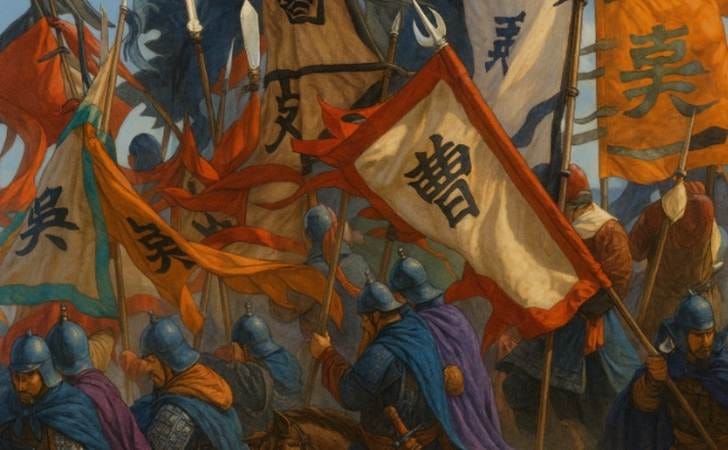
A faltering centre of power invites a storm of contenders
In ROTK, when the people no longer saw the emperor as favoured by Heaven, they did not hesitate to turn to new lords. In business, the dynamic is the same. Once that mandate weakens, the shift is swift.
For us as investors, this helps us understand that legitimacy must be cultivated deliberately. It is not a cost centre but a strategic terrain.
In the rest of the post, we will see how this terrain and reservoir of belief, can defend against disruption better than any patent or capital buffer. And how even a well-run enterprise can find itself outflanked by a rival that simply seems more deserving.
The mandate may be invisible. But its effects are not.
The Anatomy of Power
In strategy, power is not one thing but a sum of forces. It is not merely capital or market share, nor charisma or cleverness alone. True power that is durable, compounding and strategically decisive, rests on three foundations.
Logistics, Information, Morale.
Each of these has its ancient analogue. The generals of the Three Kingdoms did not conquer by force alone. They moved grain before troops, mapped terrain before marching, and inspired loyalty before issuing orders. So too, in economic warfare, these three components define whether a company can not only win, but endure.
Logistics is the base layer. In ROTK, logistics meant access to food, arms, horses, and fortifications. No general, however brilliant, could fight with empty granaries. Today, logistics means control of supply chains, capital efficiency, and operational resilience.
A firm strong in logistics has secured critical resources, built superior production systems, and ensured financing at scale. This is the power of stamina. It does not shine like product innovation, but it outlasts.
In wartime parlance, amateurs talk tactics while professionals talk logistics.
Cao Cao’s grip on the grain supply, mundane as it seemed, proved more decisive than any battlefield flourish. In short, logistics is the power of endurance and scale, the hard backbone of economic war.
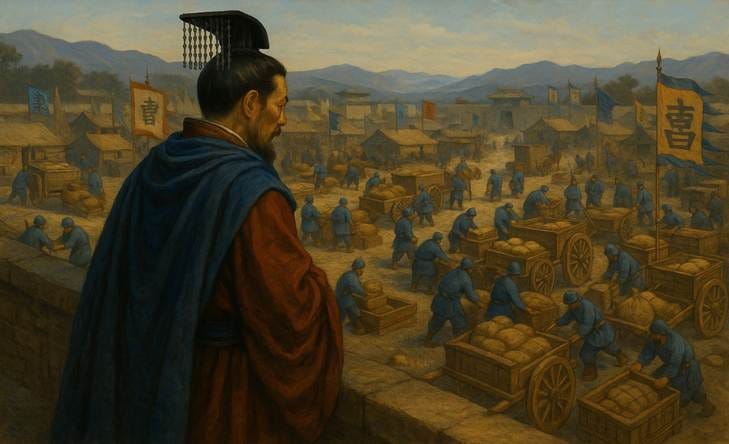
Armies win battles, supply lines win wars
Information is the second pillar. In ancient battle, this meant scouts, spies, signals. Knowing where the enemy moved and when. Today, it is data, analysis, and foresight. Firms that excel in information harness technology to read markets before others, to learn from their own feedback loops, and to mask their intent when needed.
During the Three Kingdoms period, it was Zhuge Liang who turned deception and planning into art, giving his lord, Liu Bei, disproportionate advantages. A modern firm that reads the field well, be it through AI, consumer analytics, or a culture of insight, can operate one move ahead.
This is the power of anticipation and invention.
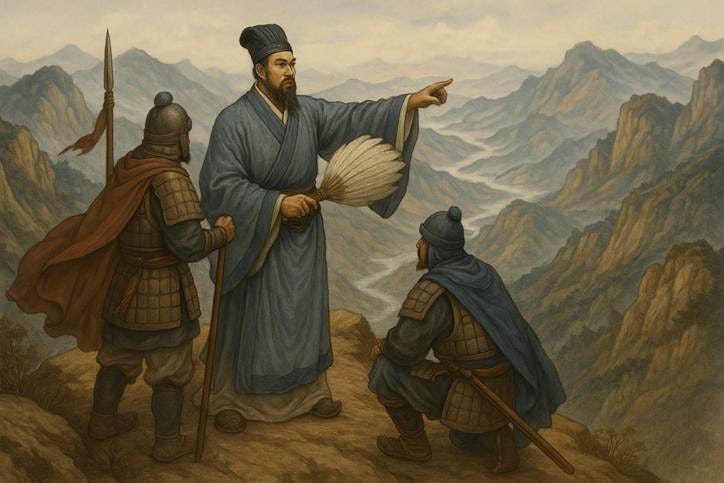
Spies and messengers mattered as much as swords. War is decided not by might, but by insight.
Morale is the final leg and perhaps most human and often underestimated.
In war, morale decides whether armies break or stand. In business, it determines whether teams stay aligned under stress, whether customers remain loyal in a downcycle, and whether investors believe the story long enough for the strategy to unfold.
In ROTK, leaders like Liu Bei inspired almost fanatical loyalty. Whole armies marched on the strength of a narrative of restoring the Han or avenging a fallen brother. Today, this maps to brand ethos, company mission, or charismatic leadership. It is what makes people care. This can manifest as consumer goodwill or as employee dedication.
Morale power also extends to investor sentiment. A compelling story can keep capital flowing even in lean times. Just as a commander’s presence on horseback waving a banner can turn the tide of a medieval battle, a strong corporate narrative can sustain a company through crises that would break others.
Morale is the power of purpose and belief. Intangible but potent.
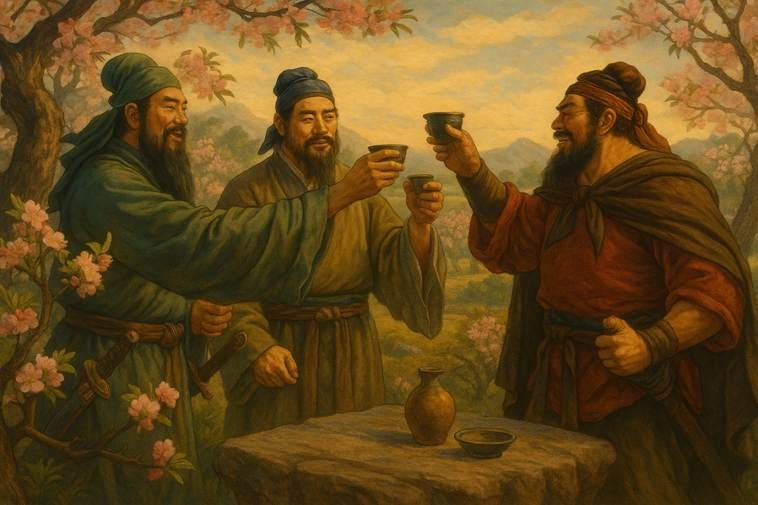
Liu Bei, Guan Yu, and Zhang Fei swore brotherhood under the blossoms and from that vow came loyalty and morale no empire could buy.
Logistics. Information. Morale. Together, they form the anatomy of power. Alone, each offers advantage. Together, they compound into a strategic edge that is hard to dislodge. Throughout this piece, we will return to this triad. We will see how one dominates in logistics, another manoeuvre via information, and yet another rally morale to punch above its weight.
Power, in this sense, is not declared. It is built patiently unseen and in layers. And those who understand its structure, can learn to wield it.
The Four Archetypes of Ambition
Every age of upheaval produces its own grammar of leadership. In ROTK, the collapse of central order did not yield chaos, but character. Ambition, in such times, becomes a kind of natural force. Less a personal drive than a pattern embedded in the shifting terrain.
As China fractured, three poles of power emerged, not merely because of their geography or armies, but because of the men who led them, each a living theory of power. What they achieved was not accidental, but archetypal.
Source: Evolution of territory controlled by Chinese states between 190 and 280 CE
Cao Cao, Sun Quan, Liu Bei and Zhuge Liang, stood not only as rulers and rivals but as blueprints of ambition. Zhuge Liang, though not a sovereign himself, shaped the fate of kingdoms through strategy alone. He is proof that ideas alone, in the right hands, could rival armies.
They embodied distinct responses to disorder. One through consolidation, one through negotiation, one through vision, and one through cunning. Though drawn from a 14th-century narrative, their blueprints map cleanly onto modern strategic behaviour. In this section, we examine these four archetypes.
Administrator, Diplomat, Idealist, Strategist
These are not to be read as convenient metaphors, but operational postures in the theatre of economic warfare.
Cao Cao: The Administrator
Cao Cao of Wei Kingdom, emerges from the narrative less as a man and more as a machine of order. To read his campaigns is to watch discipline eclipse chaos, logistics outlast valour.
His genius did not lie in battlefield gallantry, but in provisioning, securing the northern granaries and taxing supply routes.
He was not afraid to be feared. In fact, he preferred it.
“Better to betray the world than let the world betray me,” he once declared.
Not as cruelty, but as rational prophylaxis.
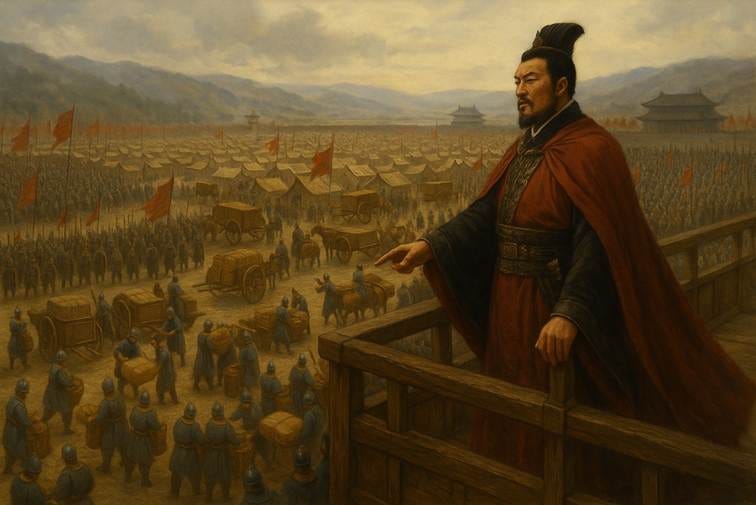
Cao Cao understood what the saga makes clear. Charisma raises an army, but only organization sustains one.
The Administrator archetype is defined by control. Control of inputs, cost structures, margins, timelines.
It is not seductive, but it is decisive. In a competitive landscape, this figure builds scale through rigor, not romance. Efficiency is the weapon.
Whether in ancient Xu Chang (the de facto capital and administrative centre established by Cao Cao) or a modern industrial hub, the Administrator thrives by reducing variables.
If a Cao Cao archetype is respected, it is because his system works. His weakness? That systems, when too optimized, can ossify. That fear, while useful in crisis, may not inspire loyalty in the long arc. But so long as the conflict endures, this archetype survives longer.
Sun Quan: The Diplomat
Sun Quan who inherited the Kingdom of Wu, ruled not by being the strongest, but by surviving the longest. His court at Jianye (the capital of the Kingdom of Wu, located on the Yangtze River) was neither the richest nor the most devout, but it lasted, anchored by the twin virtues of timing and compromise.
He won the most decisive battle of the era, “Red Cliffs”, not through solo force, but by lending his fleet to an alliance. He understood that power in fractured times is not always held, but borrowed.
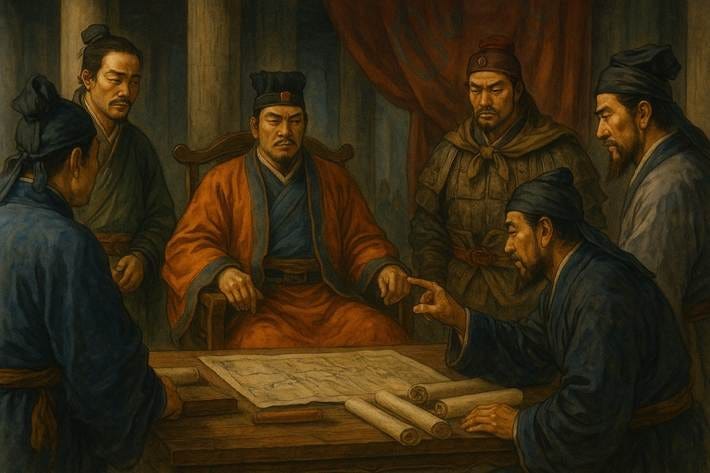
Sun Quan shows the diplomat’s edge, power woven not from stores of grain, but from networks of obligation.
The Diplomat archetype accumulates leverage through negotiation. Unlike the Administrator, he does not hoard resources but builds webs of obligation. This is the operator who makes joint ventures that shift markets, or aligns with regulators to stall a rival. His strength is agility, but agility requires balance.
Alliances must be curated, interests aligned, egos managed. The Diplomat’s danger lies in dependency. If partners defect or the coalition frays, there may be little held in reserve. But in a world of shifting coalitions and volatile sentiment, this archetype often survives when others fall.
Liu Bei: The Idealist
In ROTK, Liu Bei as ruler of Shu Kingdom, is an enigma. A ruler who started out with no territory, a warlord with no surplus, a general who survives through defeat.
Yet his cause lives on. His power is not material but emotional. “Restore the Han,” he proclaims and men believe it, bleed for it, die for it. What he lacks in scale, he recovers in loyalty. He commands no great treasury, yet the greatest strategist of the age joins him freely.
The Idealist is powered by narrative. This figure cannot always match rivals in size or price, but compensates through devotion. The loyalty of customers, the commitment of employees, the patience of backers.
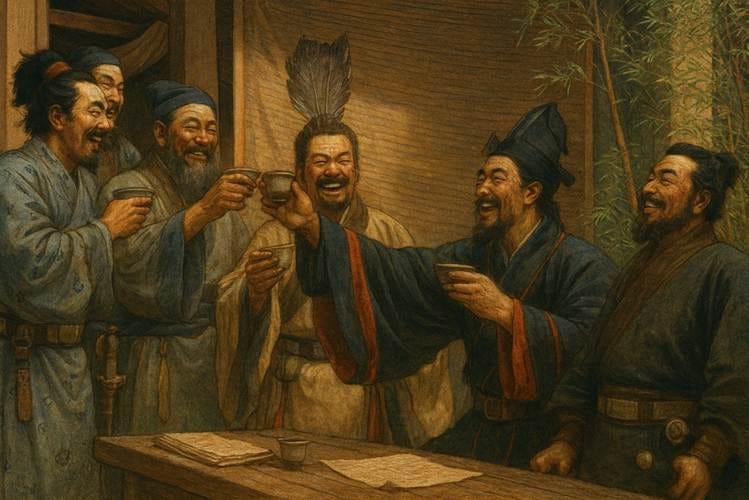
Liu Bei’s power was not in armies, but in the hearts he bound to a shared ideal.
This is the founder who builds a culture rather than a company. Morale is his capital. But like all soft power, it is fragile. If the vision dims, or a betrayal occurs, the edifice crumbles. Charisma can bind but only as long as it inspires. Yet, in environments where brand, authenticity, and belief matter, the Idealist often wins what armies cannot. The heart and minds of people.
Zhuge Liang: The Strategist
Zhuge Liang, or Kongming, steps into the story not as a prince but as a scholar. He was sought out through three arduous visits to his thatched hut yet his mind alters empires.
With no great army, he creates phantom ones. With no surplus, he builds oxen from wood and fields from smoke. He writes letters that frighten tyrants and plans retreats that look like advances.
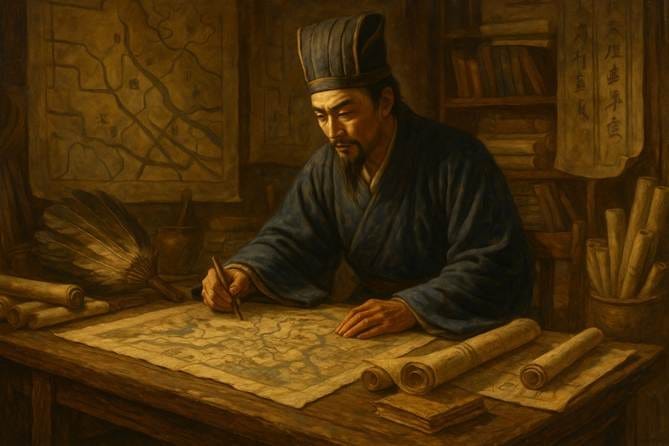
In a world of warlords, Zhuge Liang needed no sword, only a map and a mind that could move mountains.
The Strategist archetype is not defined by volume but by leverage. He does more with less. Whether through intellectual property, regulation, or timing, the Strategist alters equations.
He sees hidden paths. That one policy can halt a rival’s expansion, or that one algorithm can level a billion-dollar moat. His risk, of course, is fragility. If the plan fails, there is no fallback.
His strength lies in insight, but insight must be timely and sometimes the world turns faster than genius can adjust. Still, for every age, a strategist reorders the map without ever holding a sword.
These archetypes of Administrator, Diplomat, Idealist, Strategist are not fixed roles but enduring patterns.
These figures appear wherever competition exists. In any sector, one may dominate through cost control, another through coalition, a third through narrative, a fourth through cunning.
Often, these types collide, just as they did in ancient China, each exposing the limits of the others. The Administrator may run out of allies. The Diplomat may lack conviction. The Idealist may falter in the face of logistics. The Strategist may run out of time.
But what ROTK teaches, and what every market reorganization affirms, is that victory is never just a matter of scale or strength. It is a contest of strategic character. And character, once tested, rarely conceals its true nature.
The Seven Stratagems of Economic Warfare
The ROTK is, at its heart, a chessboard of cunning manoeuvres. Less a litany of brute-force engagements and more a compendium of wits, deceptions, and patient positioning. It is here, not in raw might but in strategic craft, that modern economic minds will find their truest mirror.
The following seven stratagems are drawn from this vast chronicle. Each is a case study in advantage won not by scale but by sharpness. (The saga holds dozens more. These seven are offered here not as an exhaustive catalogue but merely the ones most useful as a narrative toolkit for the next post, where we dissect an industry in turbulence.)
Translated for modern conflict, they illuminate how investors can identify the businesses that prevail not merely through innovation but through the patient application of leverage, timing, and guile.
1. Guandu: Attrition Over Spectacle
The Battle of Guandu (200 CE), the pivot point that created the military and political landscape from which the Three Kingdoms era began to form, was not won through overwhelming force, but by turning scarcity into leverage. Warlord Yuan Shao commanded a vastly larger army than his rival, Cao Cao, by some accounts, more than ten times the size.
On paper, victory seemed inevitable. But Yuan Shao was overextended, poorly coordinated, and burdened by a bloated supply line that stretched back hundreds of miles.
Cao Cao, by contrast, led a smaller, tighter force with ruthless efficiency. Instead of confronting Yuan head-on, he struck where it hurt most. The grain depot at Wuchao (the vital supply depot for Yuan Shao’s armies during the Battle of Guandu), Yuan’s logistical lifeline.
In a surprise night raid, Cao’s men torched the vast storehouses. The result was chaos. Without food, morale collapsed. Yuan’s mighty army disintegrated not in a dramatic clash, but in exhaustion, confusion, and retreat.
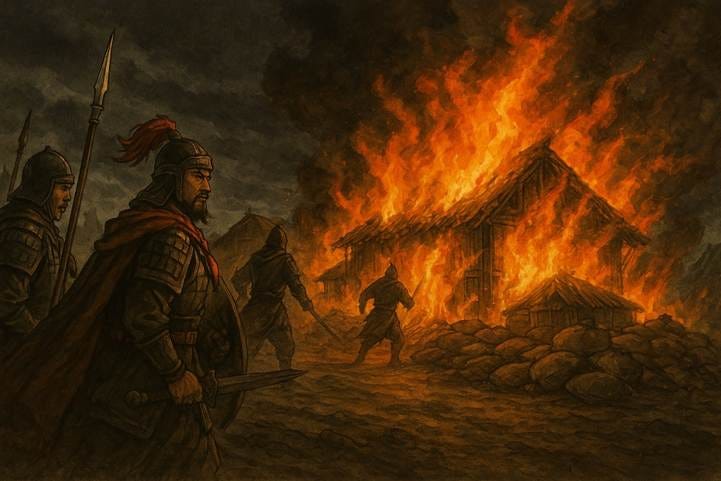
Battle of Guandu. The moment when a smaller, sharper force broke a giant by striking its supply chain, not its soldiers.
The lesson is enduring. Stamina outlasts spectacle. In markets, companies that chase hypergrowth, piling into new users, flashy launches, or valuation theatrics, often outrun their fundamentals. When capital tightens or sentiment shifts, momentum evaporates and the overextended stumble.
Meanwhile, the disciplined operators, those who guard burn rate, fortify supply chains, and protect margins, quietly gain ground.
Guandu reminds investors that strategy begins with arithmetic, not theatrics. The winners are the firms that ration resources, preserve optionality, and stay solvent long after the loudest players fade.
Survival is not just a prerequisite for compounding. It is the edge.
2. Battle at Red Cliffs: Coalition as Counterweight
At the turn of the 3rd century, warlord Cao Cao had marched south with the largest army China had ever seen. Some 800,000 strong by legend.
His goal was conquest. To unify China under his banner by crushing the smaller southern powers of Liu Bei and Sun Quan. Individually, neither could withstand him.
Liu Bei was a dispossessed noble with limited troops, still reeling from defeats. Sun Quan was a coastal prince, strong in defence but wary of provoking a northern giant.
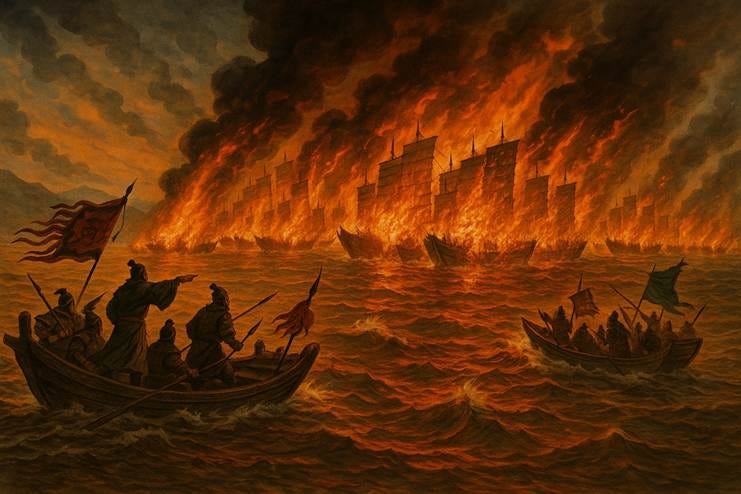
Red Cliff is proof that scale without strategy is tinder. One well-timed spark can undo an empire.
Yet, facing a common existential threat, they did the improbable by allying. The result was the Battle of Red Cliffs, a decisive naval engagement on the Yangtze River. With clever deception, fire attacks, and the benefit of southern terrain and climate, the vastly outnumbered coalition set Cao Cao’s fleet ablaze.
His grand campaign crumbled. This was not just a military upset, it was a recalibration of the entire power structure of China. The alliance delayed unification for decades and preserved multipolarity in the Three Kingdoms era.
The modern corollary is powerful.
Smaller firms can neutralize giants not by matching their scale, but by pooling what they each lack. Joint ventures, shared infrastructure, co-lobbying efforts, and open-standard coalitions turn fragmented challengers into coordinated forces.
What Liu Bei and Sun Quan lacked in size, they gained through alignment of geography, information, and trust.
Today’s alliances work the same way. EV makers co-invest in batteries to counter supply-chain choke points. Startups and regulators align to break monopolistic moats. Niche players band together to set standards incumbents must follow.
These partnerships are not sentimental, they are strategic weapons.
For investors, the question should not just be limited to “What does this company lack?” They should also turn to “Who else lacks it too, and how strong do they become if they move together?”
3. The Empty City: Perception as Deterrent
Zhuge Liang, the master strategist of Shu, once found himself in a dire position. During a campaign, he occupied a city with no troops. His defenses stretched thin and his walls undefended.
Word came that Sima Yi, commander of Wei’s formidable 150,000-man army and nemesis of Zhuge Liang, was enroute. Outnumbered and cornered, most generals would have fled or fortified in desperation.
Instead, Zhuge flung open the city gates.
He sat calmly atop the walls, playing a lute. A few elderly servants swept the streets in feigned tranquillity. There were no archers, no soldiers, no barricades. Only silence and serenity.
Sima Yi, renowned for caution, halted. He saw not an undefended city, but a trap. He imagined ambushes behind every curtain, hidden troops waiting to pounce. Paralyzed by the illusion, he turned back without a fight.
Zhuge’s troops were saved, by nothing more than the power of perception.
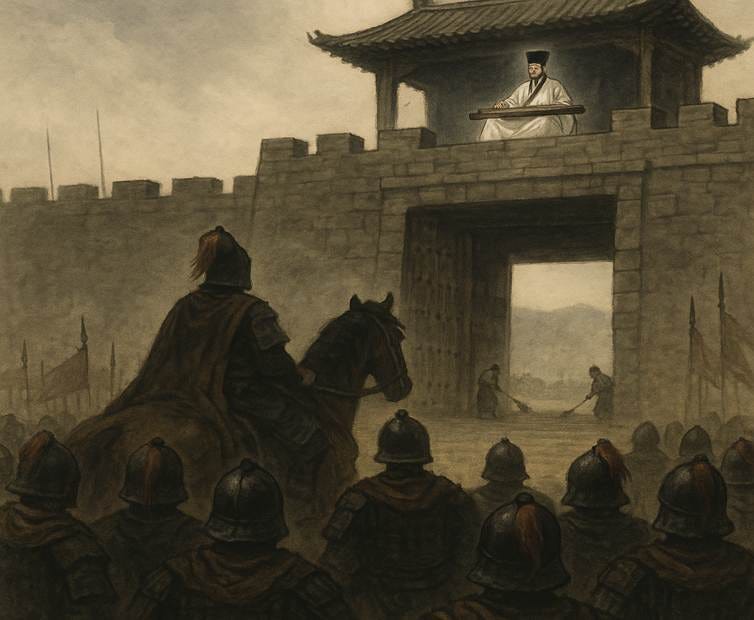
In the Empty City stratagem, Zhuge Liang wins without soldiers, only psychology.
The bluff worked because Zhuge understood psychology as well as war. He knew that in the absence of data, fear fills the void. Silence becomes noise. The mind draws monsters in empty spaces.
In business, as in war, there are moments of extreme vulnerability, when the runway is short, a product is delayed or competitors loom. Showing that weakness openly can invite ruin. Investor panic, competitor aggression, customer churn.
That is when companies may invoke their own version of the Empty City Stratagem. Crafting a projection of strength, composure, or momentum precisely to conceal fragility.
This is not deception for deception’s sake but narrative triage.
A cash-strapped startup may host a glitzy product launch to suggest deep confidence. A struggling incumbent might announce an ambitious pipeline of innovations to deter rivals from moving in. Even earnings calls are sometimes calibrated more for tone than truth, where confidence itself becomes the moat. The hope is to delay confrontation, buy time, and live to fight another day.
Strategic bluffing works not because it lies, but because it plays with the opponent’s assumptions. Sima Yi retreated not due to facts, but to what he could not afford to disbelieve. In markets, as in campaigns, perception often outruns substance.
Of course, this tactic is high-risk. If the bluff is called, if the gates are entered, the illusion shatters. But used sparingly, and with clear intent to bridge toward real strength, it can be decisive.
The broader lesson for the investor is to apply the Empty City Stratagem in reverse.
Do not mistake strategic confidence for fundamental strength.
When a company’s stock price or survival depends on delaying a confrontation, management will deliberately maximize the Fear, Uncertainty, and Doubt (FUD) of its competitors while minimizing the FUD of its own shareholders.
When you see a struggling company relying heavily on tone and forward-looking vision, remember the lesson: “When you cannot fight, make your enemy believe you are waiting to.”
The investor’s job is to verify if the reinforcements are actually on the way, or if the city is truly empty.
4. Borrowed Arrows: Use Rival Resources
In one of the most iconic displays of cunning in ROTK, Zhuge Liang as chief strategist for Liu Bei, faces an impossible task. To deliver 100,000 arrows for the coming battle at Red Cliffs in just three days.
Lacking time, manpower, and materials, he devises a bold plan.
Under cover of dense fog and night, he dispatches a fleet of small boats toward enemy lines. These vessels are covered with straw-wrapped mannequins and appear to be part of an eerie, silent assault. From the opposite shore, Cao Cao’s startled archers unleash a storm of arrows, pelting the decoys with thousands of missiles.
Once satisfied, Zhuge’s crew turns the boats around, now bristling with enemy arrows, and sails home. In one stroke, he fulfils the quota, arming his side not by production, but by provocation. He did not make the arrows. He “borrowed” them from his enemy.
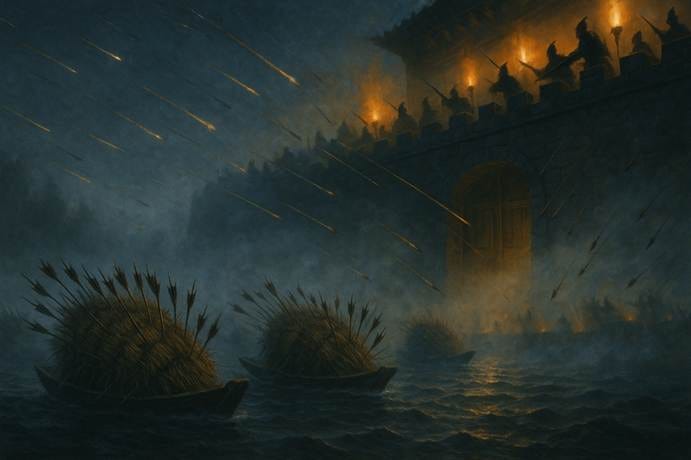
Under fog and torchlight, Zhuge Liang gathers a storm of enemy arrows and sends them home as his own. Markets reward the same logic. True winners do not outproduce, they out-leverage.
This is more than clever wartime deception. It is a masterclass in strategic leverage. Transforming a rival’s strength, readiness, and resources into your own gain.
Today, this manoeuvre has direct analogues in modern business strategy. Call it infrastructure piggybacking, regulatory arbitrage, or platform opportunism.
It is the startup that builds on Amazon Web Services instead of owning its own servers, conserving capital while riding on the cloud giant’s back. It is the fintech that integrates into old banking APIs, accessing customer data and transactions through legacy systems its competitor maintains. It is the ride-share app or delivery startup that utilizes existing road infrastructure, GPS networks, and mobile penetration. Built and paid for by others.
Sometimes, it is more tactical. Consider companies that outsource manufacturing to rivals’ excess capacity, letting a competitor absorb the fixed costs. Or when regulators compel a telecom incumbent to lease its network to smaller players, the smaller firm now sells services using the incumbent’s infrastructure. These firms did not invest in the “arrows”, they cleverly arranged to collect them.
The brilliance of Zhuge Liang offers a masterclass in asymmetrical investing. His genius lay not in raw power, but in reading the board, mapping weakness hidden inside an opponent’s strength. He understood that when market leaders are over-equipped, distracted, or mandated to share, their sheer abundance can be weaponized.
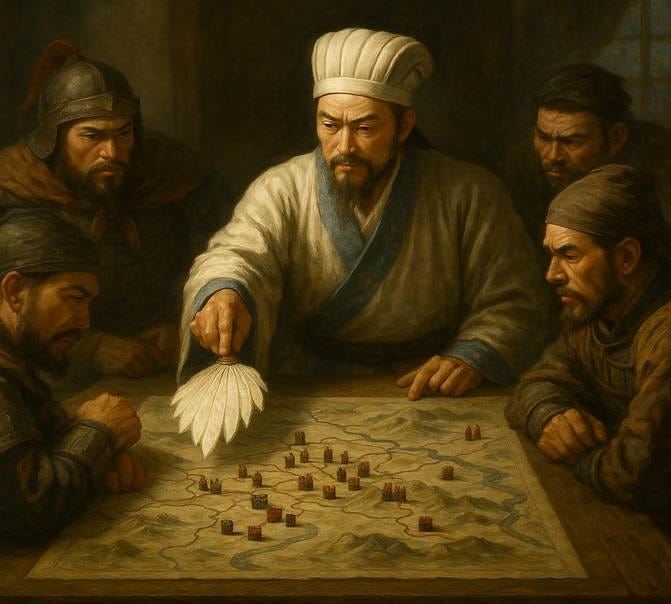
Zhuge Liang’s genius was never brute force. It was reading the board, mapping out weakness hidden inside strength.
This is the investment strategy of “Adaptive Scavenging”. The savvy investor seeks value not in the incumbent’s failing core, but in identifying the smaller firm poised to profit from the giant’s exposed assets.
The crucial question shifts from “What should the management team do?” to “Which company is best positioned to capture the surplus?”
This mindset rewards precision and opportunism. Betting on the nimble player who will reap broader consumer demand created by a rival’s overspent marketing budget, or investing in the disruptor that uses regulatory mandates to wedge into the incumbent’s proprietary infrastructure.
Value is often found not in the fortress itself, but in the supplies spilling out of its gates and the investor’s job is to identify the firm that scoops them up.
5. Battle of Hanzhong: The Indirect Attack
Military history teaches that when an enemy’s core position is too strong to break, the winning move is rarely at the front gate. It is at the flank, at the system the enemy cannot afford to lose. The classic doctrine of “Besiege Wei to Rescue Zhao” lives inside this insight. Pressure the periphery, and the centre collapses on its own.
Few episodes show this as clearly as the struggle for Hanzhong.
Cao Cao’s main force sat inside an impregnable fortress. Taking it head-on would have drained Liu Bei’s army and ended the campaign in failure. But Fa Zheng (advisor to Liu Bei) saw that the fortress was only as strong as the lifeline behind it.
So instead of battering Hanzhong’s walls, Liu Bei struck the supply base at Mount Dingjun. That single incision snapped the logistics that held Cao Cao’s position together. The great fortress became irrelevant the moment the provisions feeding it were destroyed.
Cao Cao withdrew without a decisive battle. Liu Bei won Hanzhong by never fighting the strongest part of the enemy.
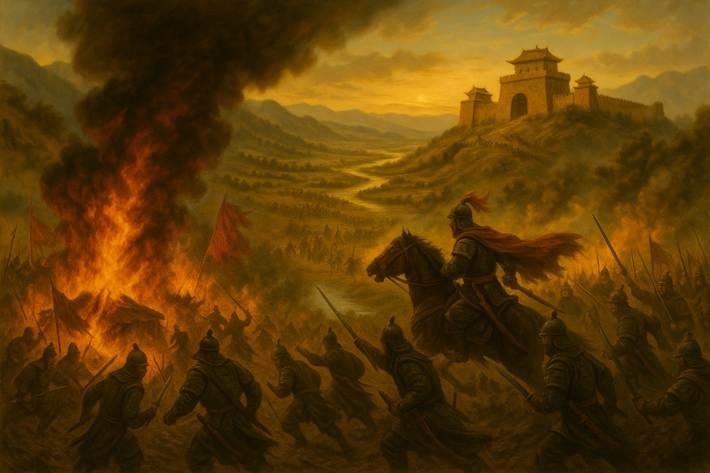
The fall of Hanzhong did not begin at its walls. It began on the slopes of Mount Dingjun, where Liu Bei cut the supply line that made Cao Cao’s fortress strong.
For investors, this is the real lesson. What looks like strength on the surface, market share, brand dominance, fortress-like moats, is often propped up by far more fragile foundations.
A distribution chokepoint. A single supplier. A regulatory shield. When these supports buckle, the core crumbles faster than any frontal competitor could manage.
The opportunity lies with the companies that attack those supports, not by making a slightly better product, but by undermining what gives the incumbent power in the first place.
Open-source alternatives that collapse pricing power. New distribution that bypasses the incumbent’s channels. Technologies that dissolve switching costs the incumbent depends on. These are the modern equivalents of Mount Dingjun. Small, precise blows that force giants into costly retreats.
For investors, this means the alpha is rarely in predicting the next product, feature, or quarter. It is in spotting the support structure that makes the incumbent’s profits possible and backing the challenger that quietly dissolves it.
That is the true translation of Hanzhong into markets. The winning investment is the one that pressures the system a giant cannot survive without.
6. Yiling Expedition: Overextension as Risk
Late in the Three Kingdoms era, Liu Bei launched a massive southern march to avenge the death of his sworn brother, Guan Yu.
It was a campaign fueled by emotion rather than strategy. He drove a huge army deep into Eastern Wu territory, far from his own supply bases. By the time he reached the cliffs of Yiling (221–222 CE), his troops were exhausted, scattered across overextended camps, and battered by the brutal summer heat.
Wu’s commander, Lu Xun, did not win through overwhelming strength, he simply waited. Once Liu Bei’s army was stretched thin and complacent, Lu Xun struck with a series of coordinated fire attacks.
The dry terrain, the long supply lines, and the bloated encampments turned Liu Bei’s own ambition into a trap. His forces collapsed not from enemy brilliance, but from their own fatigue and overreach.
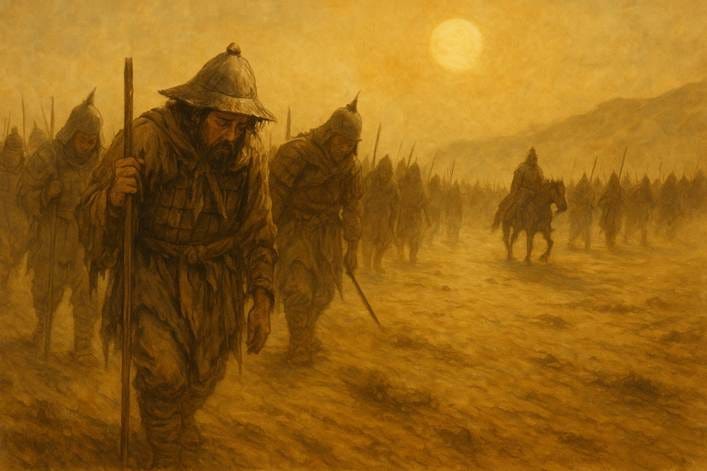
The Yiling Expedition; where heat, distance, and overreach broke Liu Bei’s army before Wu ever struck.
The lesson is timeless. Overextension destroys more kingdoms and companies than defeat in open battle.
For investors, the pattern is identical. Many companies are defeated not by competition, but by their own pace of expansion. Hypergrowth stretches supply chains, burns cash, dilutes culture, and fractures execution long before a rival lands a punch. Overextension is the silent killer.
A disciplined competitor does not need a frontal attack. They can let the overextended firm drain itself, then enter when weakness is undeniable.
The real edge goes to the business that expands only as fast as its systems, culture, and balance sheet can carry. It consolidates gains, deepens capabilities, and keeps optionality alive. The one that chases every new market, every shiny adjacency, risks burning out long before the industry crowns a winner.
Sometimes the smartest strategic move and the highest-return investment, is backing the company that knows when not to pursue the next conquest.
7. Death of Zhuge Liang: Time as the Decider
Zhuge Liang, Shu’s unmatched strategist, was never defeated by blade or ambush. He was defeated by time. On his sixth Northern Expedition, after years of grinding campaigns meant to counter Wei’s superior strength, he died in 234 CE from illness brought on by exhaustion.
Shu’s armies, already stretched thin by distance, heat, and dwindling supplies, lost not only their commander but the organizing mind that held their fragile state together. From that moment, the arc of the war bent steadily toward Wei. It was not a single battle that doomed Shu, but the slow attrition of resources, population, and leadership.
When Zhuge Liang fell, endurance, Wei’s greatest asset, became destiny. Three decades later, the Shu kingdom collapsed to Wei’s successor state, the Jin dynasty, not in a blaze of glory but under the weight of cumulative fatigue.
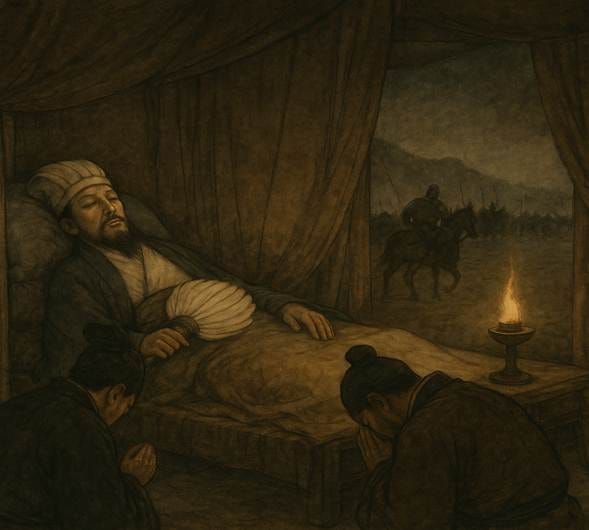
Shu lost its strategist, and time claimed the rest.
The lesson is stark. Time compounds structural advantages and erodes flashes of brilliance. It is the quiet ally of the well-resourced and the silent killer of the overstretched.
In business, the same law governs outcomes. Speed, boldness, and visionary leadership can win quarters, even years. But over long arcs, endurance decides the victor. A company dependent on a single genius or a single era, faces the same fate as Shu. When the genius fades or the era shifts, fragility is exposed.
Conversely, firms that institutionalize knowledge, build robust systems, and maintain disciplined balance sheets can simply outwait turbulence. Many incumbents survived past waves of disruption not through clever manoeuvres, but because weaker challengers burned out first.
Time remains the oldest stratagem of all. The empire that endures is the empire that prevails. In contemporary context, it is the ultimate arbiter of financial value, testing every investment thesis and competitive advantage.
As a portfolio filter, time is a ruthless acid test. Truly wonderful businesses strengthen and compound value under its passage, while mediocre ones decay and revert to the mean.
Furthermore, time acts as a succession test, revealing whether a company’s value resides solely in the charisma or brilliance of one leader or if the culture is resilient and structured to endure.
For the investor, time is a strategic lever where patience becomes positioning. Victory lies in outlasting the competition, betting on businesses with clean balance sheets and institutional resilience that allows them to “win by outlasting” those who succumb to capital exhaustion.
When empires fracture, power flows to those who understand supply, perception, and time.
Together, these seven are not formulas, but orientations. They help map the terrain of competition, teaching when to endure, when to deceive, when to pivot, and when to wait. As we move from the ancient campaign fields to modern boardrooms, their relevance only sharpens. Markets, after all, are merely battles without banners.
The Economics of Legitimacy
Warfare, ancient or modern, is never fought on terrain alone. Terrain matters, but so does the story on top of it.
In the era of the Three Kingdoms, what separated a warlord from a bandit was not just arms or titles, but the perception that he fought with moral sanction, that Heaven itself smiled upon his campaign. This was more than pageantry. It was political physics. A general who lost the Mandate of Heaven lost not just battles, but belief. And belief moves armies.
We would be mistaken to think the boardroom is free of such metaphysics. Markets do not run solely on margin and moat. They are also propelled or crippled by perception. What the ancients called Heaven’s Favor, we might now call legitimacy. The belief that a firm’s rise is deserved, that its power is tolerable, that its leaders play a game that is not zero-sum for the rest of us.
Legitimacy is not branding, though it wraps itself in brands. Nor is it ESG metrics, though it is measured through them. It is the defining force behind stakeholder deference. It allows a firm to move swiftly where others tread lightly. When a recall happens, it is what buys forgiveness. When a scandal breaks, it is what holds the line. When markets wobble, it is what invites capital rather than questions. It cannot be bought, only built. And once lost, it retreats like trust. Slowly at first, then all at once.
To the warlords of commerce, legitimacy is a campaign asset as vital as capital. It manifests in the leniency of regulators, the patience of investors, and the loyalty of customers.
Consider two automakers. One with a legacy of quality and service, the other young and volatile. A defect hits both. One is forgiven, the other pilloried. The difference is not technical but moral. One firm is presumed guilty, the other presumed human. That gap is the Mandate of Legitimacy in action.
This mandate is especially acute in moments of transition. A new entrant, no matter how inventive, must first persuade society that it belongs at the table, that it is not a usurper, but the heir.
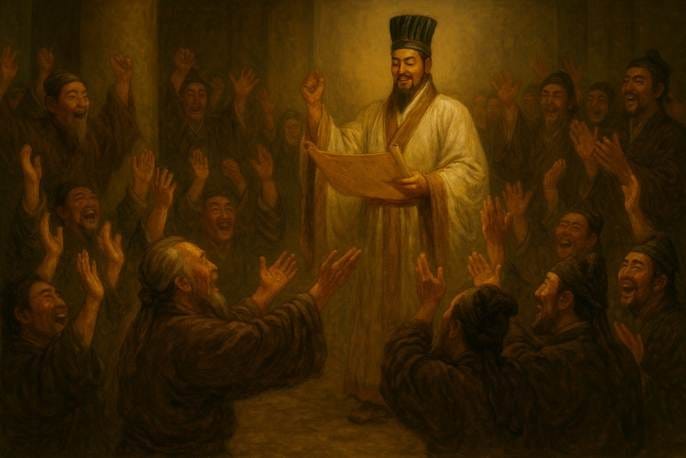
Before he built an army, Liu Bei built a story the world could accept by claiming a lineage people want to believe in.
Just as Liu Bei claimed kinship with the Han to rally allies, firms today seek to root themselves in the existing order or embody a rising one. Green energy, fair data, ethical labour. The pitch is never just “We are cheaper”. It is “We are the future”. That is a moral claim.
And this claim has weight. Valuations often reflect more than earnings. They reflect a belief in stewardship. Some CEOs are entrusted with sky-high multiples not because they are efficient, but because they are deemed righteous in vision. That belief, like gold reserves of old, anchors the currency of equity. Remove it, and liquidity vanishes.
We have seen it. Scandals that incinerate value faster than any product flop ever could. Cheating emissions tests , misusing customer data, exploiting contractors. Each a rupture of the unspoken social compact. When that bond breaks, what follows is not just legal risk, but strategic ruin.
This is why legitimacy is not ornamental. It is structural. It reduces friction across all fronts. From policy to talent, from procurement to pricing. It earns a firm time, the most precious currency in adversity. It grants optionality in crisis. And it deters enemies, who sense that to strike such a firm is to provoke public backlash, not merely a counterattack.
For investors, the lesson is subtle but profound.
Legitimacy is an investable asset. Rarely listed on a balance sheet, yet often the determining factor in who compounds over decades and who quietly falls away.
The first task is to recognize companies in which legitimacy is not an aspiration but a lived practice. This revealed in how a firm treats customers during recalls, how transparently it responds to regulatory pressure, whether it fixes errors without theatrics, and whether its governance favours stewardship over opportunistic bursts of cleverness.
When a company earns the benefit of the doubt, you can feel it in how the world reacts to its missteps. It enjoys a kind of moral multiple. Customers forgive, regulators assume good faith, and employees choose to stay. These firms compound not because they are dazzling, but because the environment around them permits them to grow uninterrupted.
The second task is to favour companies that defend this legitimacy as carefully as they defend capital. Too many management teams trade long-term trust for short-term optics. Cutting costs at the expense of quality, playing accounting games that erode credibility, or courting political influence that backfires into scandal.
Investors should view these signals the way seasoned generals saw Liu Bei’s final, grief-driven crusade after Guan Yu’s death. A kingdom burning tomorrow to settle today’s wound.
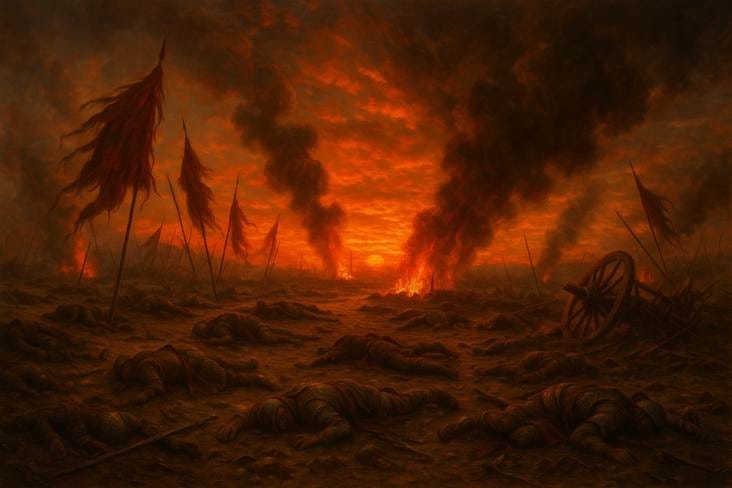
Yiling’s Aftermath: Revenge for Guan Yu and the Price of Emotional Strategy
Companies that understand legitimacy behave with a different cadence. They avoid victories that leave scars. They do not require constant reinvention to justify their worth. Their value thickens through consistency. They treat customers, regulators, and employees not as quarterly costs but as long-term allies in their own endurance.
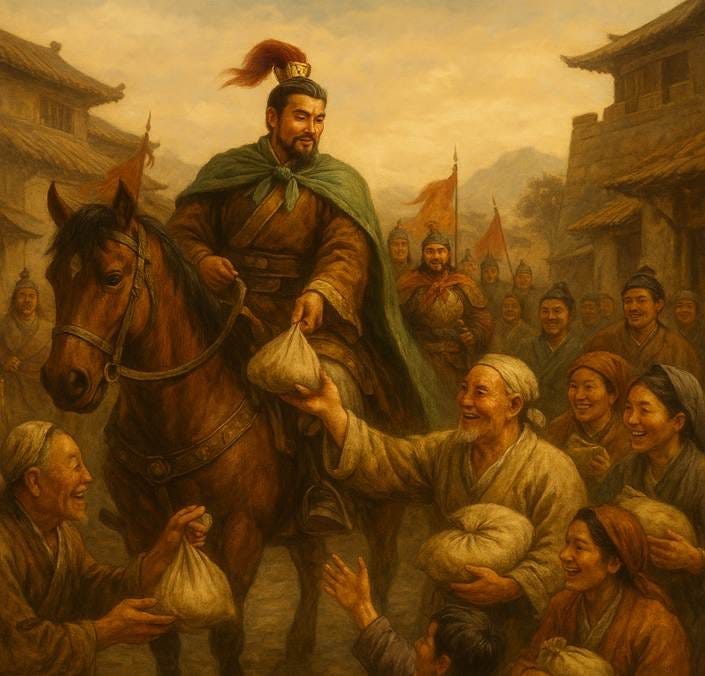
When a leader strengthens the people, the people strengthen the regime
This leads to an equation that belongs more to strategy than to accounting.
Legitimacy is the product of value and duration.
A business with legitimacy earns time. Time to repair, to reinvest, to mature its ideas, to endure storms others cannot. A business without it has no such runway. The market’s patience evaporates, and even minor errors turn into existential threats.
You see this reflected in stock charts as clearly as in history books. Companies with legitimacy suffer shallower drawdowns, recover faster, and rarely face lasting impairment. Those without it break rather than bend.
Thus the deeper diligence question is rarely, “Can this business win?” It is, “Will the world allow it to keep winning?”
In the Three Kingdoms, brilliant commanders fell when no one believed they had the right to rule. In markets, the businesses that outlast cycles and rivals are the ones whose legitimacy grants them the mandate to continue compounding.
For the long-term investor, that mandate is worth far more than any quarter’s triumph. A company that is not only competitive but trusted does not merely survive. It endures, shapes its industry’s trajectory, and writes the future.
The Mandate of Time
Empires in ROTK do not fall in a single moment of catastrophe. They erode slowly. Through exhaustion, overstretch, and the quiet arithmetic of time. Markets behave in much the same way. Time is neither an ally nor an enemy. It is merely the silent witness that remembers everything and forgives nothing. It reveals which companies merely sprint, and which can truly endure.
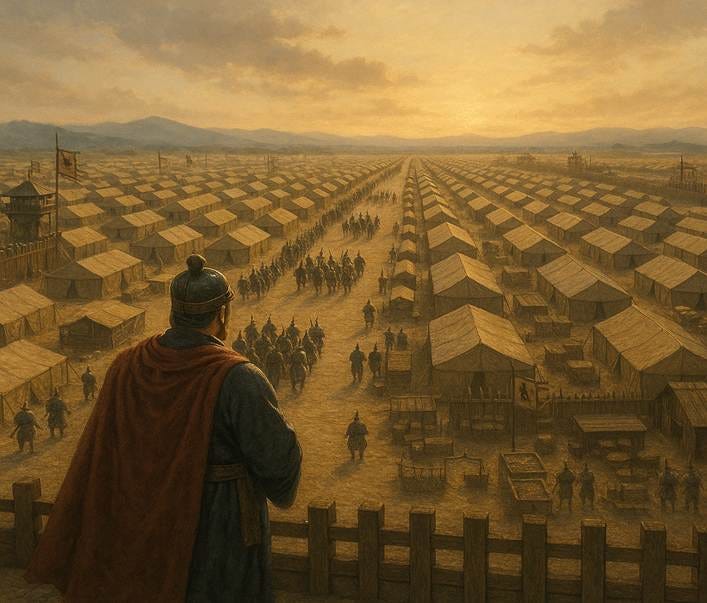
Wei Kingdom proved that time rewards the well-prepared, by building systems that survive every season.
Wei’s eventual dominance was not the product of a single stroke of brilliance but of decades of patient accumulation. Logistics that held, institutions that did not crack, a population that could absorb losses and continue. It is the same in investing.
Velocity may carry a company through a quarter, but only endurance carries it across eras. The compounders we admire today thrive not because they moved fastest, but because they built the systems, cultures, and capital structures capable of surviving whatever tomorrow brings.
This is where ROTK becomes unexpectedly useful to investors. It teaches that the battlefield rewards not only the bold tactician but the steward who can manage time. A company that earns trust year after year, through reliability, governance, and consistency, accumulates advantages invisible on balance sheets but unmistakable in outcomes.
Customer habits deepen. Networks densify. Brand equity grows. These are the moats that cannot be copied but must be assiduously cultivated.
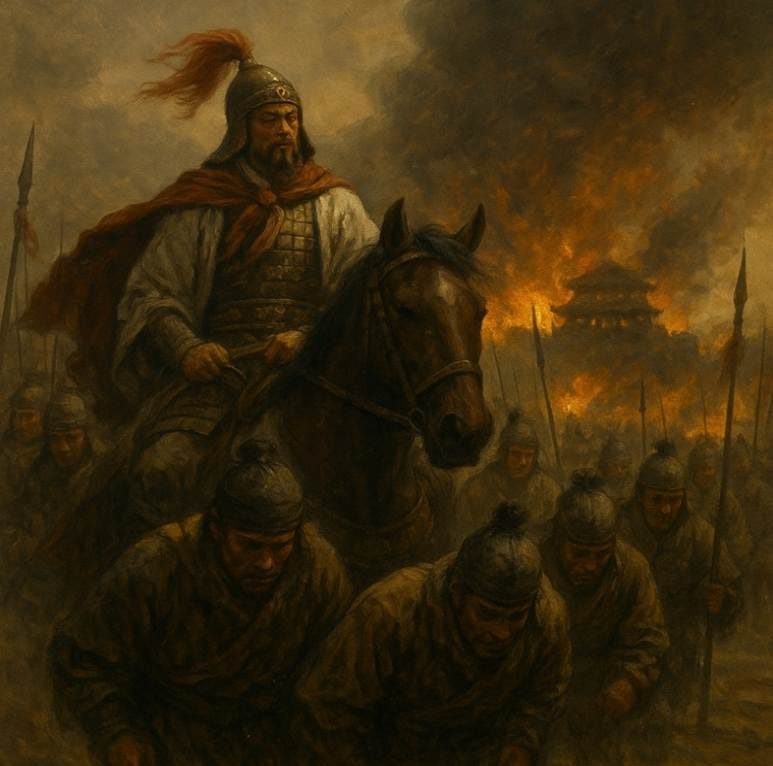
When speed outruns foundations, even the fiercest commander breaks
Many disruptors never understand this. Like Gongsun Zan, whose early victories convinced him he could expand without limits, his army surge ahead on momentum, only to outrun their foundations. They burn cash, overstretch teams, and mistake velocity for resilience. Investors who confuse fast growth with durable advantage often end up financing exhaustion rather than expansion.
The lesson is simple. Look past the sprint and study the provisions. The question is never how quickly a company advances, but how long its structure can sustain the march.
Zhuge Liang offers a different kind of wisdom. His genius was not in seeking decisive battles but in seeking the right tempo. When conditions were unfavourable, he stalled, preserved his strength, and waited for alignment. When the terrain and timing converged, he advanced with precision.
Investors who internalize this rhythm avoid the great errors of buying too early, selling too soon, or forcing a thesis that needs more time to mature. In markets, as in war, the right move performed at the wrong moment is simply the wrong move.
And beneath all of this lies the principle of optionality. The most enduring states in ROTK were the ones that built safety valves, fallback plans, and institutional depth.
The same holds true for businesses. Those with cash buffers, diversified income streams, and leadership that can adapt rather than entrench survive long after their louder rivals fade. They are built not for a single victory, but for a sequence of unpredictable seasons.
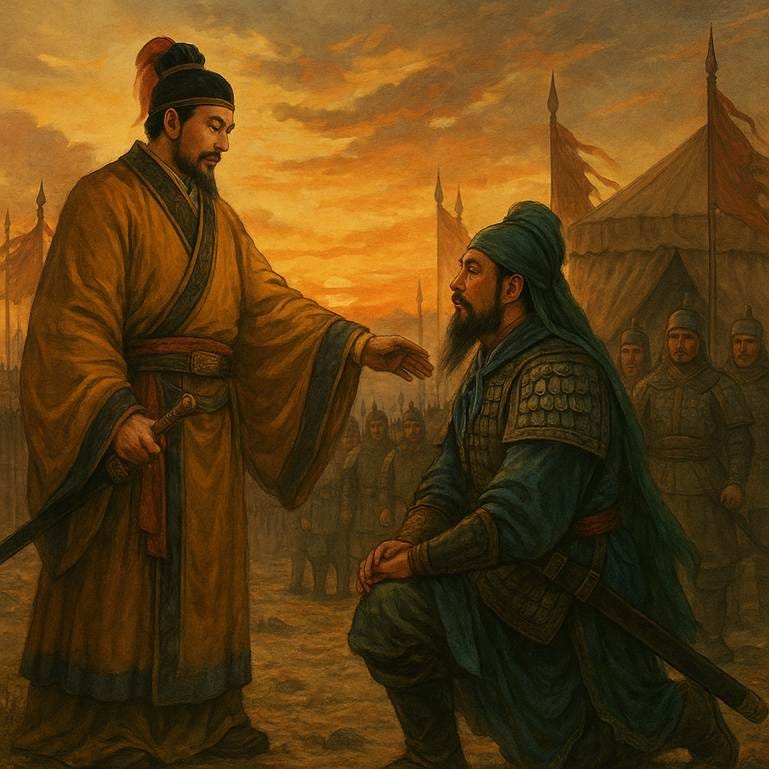
Cao Cao spares Guan Yu, not out of weakness but out of respect for a man whose honour had already earned its own protection and goodwill.
In the end, time compounds the worthy and exposes the unready. It gives generous room to a company that has earned trust and none to one that has squandered it. A stumble by a respected business is seen as misfortune but a stumble by a distrusted one is seen as confirmation. The difference is not the stumble. It is the reservoir of goodwill amassed beforehand.
So the real Mandate of Heaven in investing is, in truth, the Mandate of Time. It belongs to the companies that endure regardless, build patiently, and grow roots deeper than their headlines. These are the firms still standing when the dust clears, not because they dazzled at the outset, but because they understood the long arc of advantage.
The investor’s task, then, is to see beyond the current battle and ask the older, wiser question. “Who is not merely winning today, but pacing themselves to inherit the future?”
The Strategic Code
Across the long arc of markets, certain patterns recur with almost ritual consistency. Strip away the noise, and what remains is not a grab-bag of tactics but a philosophy of how advantage is built, defended, and compounded. Every durable philosophy eventually distills into a code.
As we close this first of 2 parts for investors, we set down that code not as a rigid checklist, but as a set of governing principles shaped by the hard lessons of the Three Kingdoms and reframed for the modern arenas of capital, competition, and long-term compounding.
1. Power in markets is a function of logistics, legitimacy, and time.
Every durable investment story rests on a triad. Capacity, credibility, and duration.
Logistics is the operational backbone of cash flow resilience, supply-chain control, margin structure and systems that keep a business compounding even when key people change. Legitimacy is the license to operate. Customer trust, regulatory goodwill, cultural alignment, the tacit permissions that let a company scale without friction. And time is the arbiter that compounds strengths, exposes weak foundations, and separates momentary momentum from enduring advantage.
Like a three-legged stool, weaken one leg and the whole structure wobbles. A company may have capital and patience, but if regulators, customers, or employees turn against it, every dollar of growth becomes harder. A firm may have public affection and narrative momentum, but if it lacks logistical depth, its promises decay into dilution and disappointment. And time will always amplify the gap, rewarding the businesses with strong fundamentals and punishing those held together by optimism alone.
For investors, the discipline is to evaluate every company through this trinity:
Which leg is weak and can it be strengthened?
Which leg is poised to compound most over the next five years?
Does this business have the right to endure, or merely the ability to excite?
Markets reward those who look beyond the quarter and track how advantage accumulates. How logistics scale, how legitimacy deepens, and how time expands a company’s strategic options. Over years, these three axes do not simply support value. They compound it and turn a good business into an unassailable one.
2. Most market battles end in exhaustion, not spectacle.
In the Three Kingdoms, no faction won through a single stroke of brilliance. They won or collapsed because one side simply ran out of time, talent, or stamina.
The same pattern governs modern markets. Platform wars, pricing races, and technology cycles rarely conclude with a decisive kill shot. They end when one competitor burns cash too quickly, loses conviction, or cannot sustain operational discipline.
For investors, this is the real lesson. Endurance is a competitive advantage hiding in plain sight. Companies that can hold ground, maintaining customer trust, preserving margins, managing morale, and keeping the balance sheet intact, often outlast flashier rivals who surge early and collapse under their own speed.
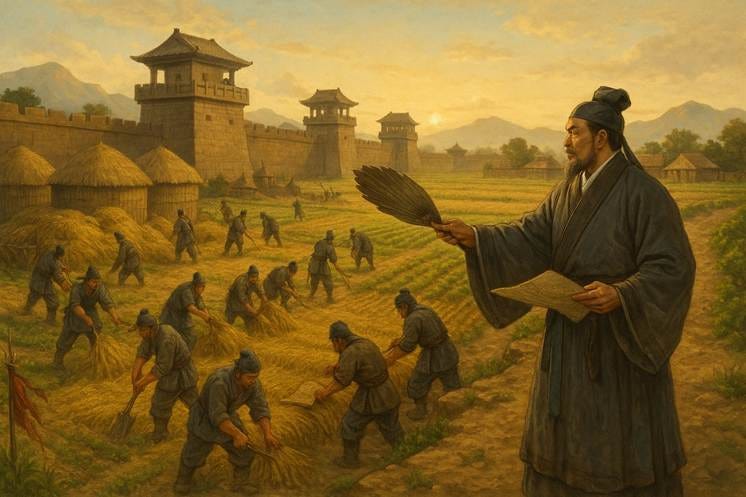
By encamping at the enemy’s border and waiting for the right moment, Zhuge Liang proved that restraint can outmatch aggression.
A good investment thesis should therefore account for fatigue. Avoid businesses forced into cost-escalating arms races. Prefer models whose economics improve with time rather than deteriorate with scale. And remember that strategic retreat is a mark of strength. A company that abandons an unwinnable initiative protects future optionality instead of draining itself.
Exhaustion is the great leveler. The winners in markets are not always the boldest, they are often the ones still standing after others quit.
3. The wise investor prizes optionality above prediction.
Markets shift, cycles turn, and the future refuses to announce itself in advance. In such terrain, rigid plans are liabilities. The edge does not come from forecasting perfectly. It comes from preserving the ability to move when conditions change.
Zhuge Liang understood this intuitively. He rarely committed every troop to a single plan. He designed campaigns with reserves, contingencies, and escape routes. His genius was not omniscience, it was adaptability.
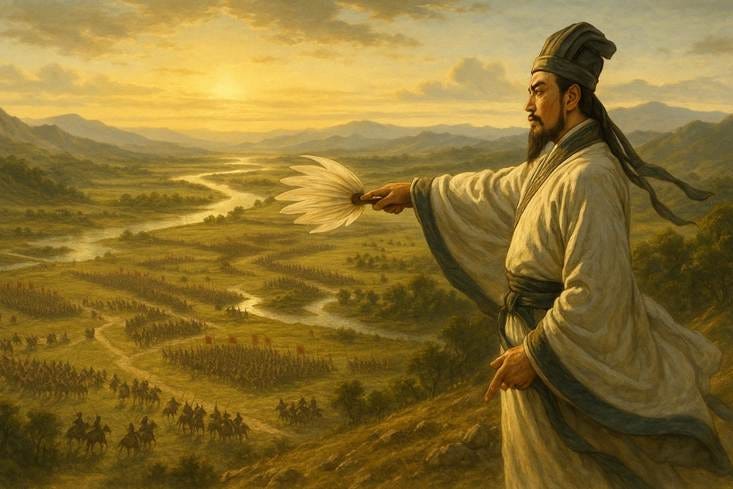
Zhuge Liang never bet everything on one future, he built plans with exits and alternatives. The companies worth owning do the same.
For investors, the parallel is straightforward. Optionality is a form of compounded resilience.
You see it in companies with diversified supply lines, strong cash balances, modular product architectures, disciplined capital allocation, and strategic hedges. These firms retain the freedom to pivot, throttle back, or accelerate as the world evolves. They do not need the future to unfold perfectly, they simply need multiple ways to win.
Optionality is not indecision, it is strategic foresight. It creates asymmetry. While competitors bet the firm on one trajectory, optional firms retain leverage when the environment shifts.
Protect optionality as fiercely as you protect capital. Favor investments that open more pathways than they close. Avoid businesses that commit themselves so fully to one outcome that they cannot survive an alternative.
A company that bets everything on a single path may find, when conditions shift, that it has nowhere left to go.
The Next Chapter
For investors, the real ambition is not to chase noise or outpace rivals for a quarter, but to hold positions that can endure, compound, and prevail without unnecessary volatility.
This has always been the deeper mandate of strategy. To win not through forceful moves, but through positioning so sound that outcomes begin to feel inevitable.
When a company earns legitimacy, it softens resistance. When it builds logistics, it strengthens its reach. When it harnesses time, the ending tilts in its favour. The investor who understands all three is not merely reacting to market swings. They are choosing businesses that shape the game rather than play inside it.
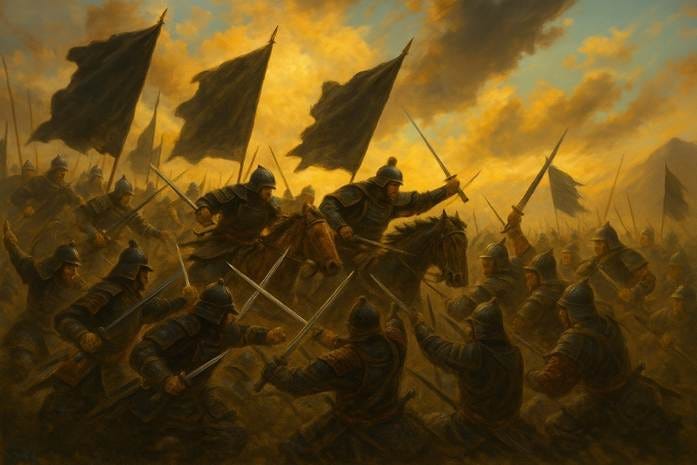
Every battle reveals where power truly concentrates. In the next post, we use the same lens to track an industry punished by externalities to locate what the market may have overlooked.
With this perspective, we will move from principle to application. The subsequent post will use the Three Kingdoms framework to locate where the true leverage lies in an industry pushed to the margins by adverse externalities and in my view, remain underappreciated by consensus.
The goal is not to just see historical parallels, but to improve our ability to detect mispriced factions, identify structural weak points, and recognize emerging centres of power before the market does.
The ROTK lens becomes not a story device but an analytical instrument. One that helps reveal which houses possess structural advantage, which are undervalued for their optionality, and which business models investors have fundamentally misunderstood.
This is fantastic work. The logistics / legitimacy / time triad is exactly the part most “moat and TAM” talk hand-waves past — markets keep paying up for the handful of firms that are boringly competent and socially “allowed” to keep winning.
The Mandate-of-Heaven → mandate-of-time bridge is doing a lot of real work here; it explains why some names walk away from scandal with a 20% drawdown and others never come back. In my world that turns into a brutal filter: who can survive an ugly decade without losing their mandate, and who’s just running a brilliant but fragile campaign.
Very curious which “discounted dynasty” you’re about to point that lens at next.
fantastic reading of ROTK - loved the applications, anecdotes, & stratagems; well done!